Showing posts with label astronaut. Show all posts

Wednesday, December 15, 2021

Apollo 14 Surface Navigation Problems

During their lunar exploration in 1971, Apollo 14 moonwalkers Alan B. Shepard Jr. and Edgar D. Mitchell had some unexpected problems navigating on the rugged surface.

Fifty years later, this conversation from their technical debriefing still has value for Artemis astronauts.

Alan Shepard assembles a double core tube as he stands beside the portable workbench or
modular equipment transporter (MET) unique to this mission during the
 second moon walk on Feb. 6, 1971. 
Credits: NASA/Edgar Mitchell


SHEPHARD

Until we really get a feel for navigation on the surface, there should be some strong check points to follow.

First of all, it gives you a feeling of security to know where you are. You know where you are distance-wise and what you have left to cover.

Second, there's no question in my mind that it's easy to misjudge distances, not only high above the surface -- that we discussed before -- but also distances along the surface.

It's so crystal clear up there -- there is no closeness that you try to associate with it in Earth terms -- it just looks a lot closer than it is.


Edgar Mitchell moves across the lunar surface as he looks over a traverse map during
exploration of Fra Mauro. Lunar dust can be seen clinging to the boots and legs of the
space suit. 
Credits: NASA/Alan Shepard

MITCHELL

I certainly agree with that. I think there are two problems that affect your distance measurements.

One, as Al described, and the second is there has to be a little bit of distortion in the bubble. I don't know how much that contributed to it, but I think it contributed some.

I believe that our primary problem in navigation was the surprise brought about by the roughness and the undulation of the terrain.

We couldn't see -- one set of landmarks, the prominent landmarks -- our next set of landmarks from our present position.

Large craters which we expected to be able to see standing out on a reasonably flat plane were not on a flat plane. They were hidden behind other craters, ridges, and old worn-down mounds.

You'd say , "Well, this next big crater ought to be a couple of hundred meters away, or 100 or 150 meters." It just wasn't anywhere in sight.

So you'd press on to another ridge and you still didn't see it. All you would see would be another ridge. Finally, you'd get over to it and there it was. You could not get enough perspective from any one spot to pin down precisely where you were.

...but that was kind of the feeling I had. I never knew what to expect when I went over the ridge of the sand dune or what I was going to see on the other side of it.

SHEPHARD

I think that complicated our problem. I don't know what to suggest on that.

I think that we have talked about navigation problems before. We always felt that you know you'd see these craters out here. Men have planned for them and they're very well defined and we ought to be able to locate them easily, but that just isn't the case.

There has to be more thought given to some better way of positioning oneself on the chart.


Source: "Apollo 14 Technical Crew Debriefing"; February 17, 1971; https://www.hq.nasa.gov/alsj/a14/a14-techdebrief.pdf


Thursday, December 9, 2021

Astronaut John Glenn

John Glenn served as a pilot in the United States Marine Corps. In 1957, he set a speed record when he flew from Los Angeles to New York in less than 3 1/2 hours.

In 1959, he was picked as one of NASA's original seven Mercury astronauts. He was the first American to orbit the Earth in 1962 aboard his tiny capsule named "Friendship 7".

Source: NASA

In 1998, at age 77, he flew aboard space shuttle Discovery for nine days. At that time, he was the oldest human to launch into space.

Source: NASA

I am proud to have this autographed photo of John Glenn in my home office.


More info:

[1] "Profile of John Glenn"; NASA; https://www.nasa.gov/content/profile-of-john-glenn

[2] "Who Was John Glenn?"; NASA; https://www.nasa.gov/audience/forstudents/k-4/stories/nasa-knows/who-is-john-glenn-k4.html

[3] Image Gallery; NASA; https://www.flickr.com/photos/nasa2explore/sets/72157677594211745

Saturday, December 4, 2021

Dick Gordon: Sleeping at the Moon

During Apollo missions to the moon, the command module pilot (CMP) stayed in lunar orbit while the two other astronauts landed and explored.


Dick Gordon was the CMP on the second moon landing mission, Apollo 12, in 1969.
Photo: NASA

After the mission, CMP Dick Gordon attended a debriefing in December 1969, and he had this to say about sleeping in space...

Sleep is probably an individual preference. I definitely had a preference for actually sleeping in the couch. I slept in the couch all but two nights.

These two nights, I slept in the sleeping bag underneath the number 1 couch, the left-hand couch. But it was always my preference to put the sleeping bag on, then get in the couch, and tie myself in the couch with a harness.

For some reason , I slept better with the lap belt and the shoulder harness on, and securely lashed down to the couch, rather than free floating or being suspended in the sleep restraint under the couch.

That was just a personal preference and it seemed to work better for me.

During sleep periods, I would wake up maybe two or three times. I would look around the spacecraft and make sure everything was okay and then really go back to sleep.

I got extremely tired at the end of that first day of lunar orbit activities. That sleep period was scheduled to be a relatively short one anyway. It necessarily turned out to be so because at the end of the day was the ... lunar orbit plane change number l occurred.

The CMP was alone in the command module during the lunar excursions. When his orbit went behind the moon, he was completely out of contact with every human everywhere. Gordon goes on to say:

But then I found that I had to do all the housekeeping and presleep activities by myself, whereas the 3 of us had been able to do them before and to clean them up in fairly rapid order.

It took a considerable length of time to wade through all that by myself, and this cut short the sleep period. So I actually was pretty tired in lunar orbit and didn't really catch up until one day out of lunar orbit on the way back.

I don't think anybody's performance was affected by fatigue and I'm not sure that fatigue really came into play. But certainly most of us in this particular occupation are used to performing while we are fatigued.


Source: "Apollo 12 Technical Crew Debriefing"; December 1, 1969; https://www.hq.nasa.gov/alsj/a12/a12-techdebrief.pdf

Wednesday, December 1, 2021

Apollo Docking Emergencies


Image: NASA


Apollo Lunar Orbit Rendezvous

During the Apollo moon landings in the 1960s and 1970s, two astronauts landed on the moon in the lunar module (LM). The third astronaut remained in lunar orbit in the command service module (CSM).

After the lunar mission was completed, the two moonwalkers would discard much of their unnecessary equipment (like their life support backpacks) and launch back into orbit.

But what would they do if the LM could not properly re-dock with the CSM?

Spacecraft Design

Both spacecraft had two doors. One was in the roof, and one was in the side.

The roof doors were where the two vehicles docked. The "tunnel" was the connection from the top of the CSM to the top of the LM.

When both craft were correctly docked, astronauts could travel easily between spacecraft using the tunnel.

But each spacecraft also had side doors. On the LM, the side door was where the astronauts came and went on the lunar surface. On the CSM, the side door was only used at launch and landing.

Later, on Apollo 15, 16, and 17, the side door was used when the command module pilot went outside to collect film canisters.

Image: NASA

Docking Failures

No docking failures were ever encountered in lunar orbit, but astronauts and mission planners gave it considerable thought.

The thinking revolved around two choices:

1. Transfer through the roof doors.
2. Transfer through the side doors.

Technical Debrief Discussion

In 1970, after successfully returning to Earth after a crippling explosion, the Apollo 13 crew discussed their thoughts on these choices with Deke Slayton (Chief of the Astronaut Office) and others.

The topic came up about "transfer from the LM to the CSM, if you were not properly docked."

LOVELL We did the WIF [Water Immersion Facility] exercise, and my feelings were that if we ever were faced with that in reality we were in deep trouble. As a matter of fact, we came up with a new technique.

HAISE We had several ways to go. You go through the tunnel or you could go outside. All we determined was that we couldn't make it through the tunnel.

LOVELL No, but we were trying to determine if we could use the PLSS [Portable Life Support System, backpack] from the lunar surface. Remember we wanted to leave the PLSSs on instead of taking them off.

HAISE We never had a PLSS on, in the water tank.

LOVELL Remember that late in the game we were talking about using a PLSS with John down at the Cape in the one-g mockup. I'm trying to see what the situation was that set us up so we could use that. We said instead of taking the PLSS off and putting the OPS [Oxygen Purge System] on.

HAISE We never did any training for that though. There was some idle conversation about that one day, because the hatch jammed and wouldn't seal. It was stuck in there and we couldn't pressurize the LM.

LOVELL Yes, but the normal thing was to get rid of the PLSS.

HAISE Yes. Do a vacuum mate/demate.

LOVELL I think you would be much better off to leave the PLSS on and do the EVT [Extravehicular Transfer] with the PLSS, because you would have communications and you wouldn't have to do all that vacuum demating and mating and get all that stuff squared away.

HAISE You never get even one-g, on the ascent stage. Why don't you just lift off with the PLSS on your back, and go into orbit that way?

SLAYTON It depends entirely on what your failure mode is. Even in that case, if you get docked, you can get repress from the CSM and get back to normal, anyway.

LOVELL We were looking at the case where we had no LM pressurization, and, we couldn't go to the tunnel. We had to go exterior.

We thought that we could even recharge our PLSS with the LM system under vacuum conditions, better than we could take off the PLSS, put on the OPS, and pressurize.

We were willing to launch with the PLSS on our back and transfer that way, because we would have communications that way. It would take a long time, maybe 4 hours to recharge the PLSS. That was the only change we had on that.


Diagram from Apollo 10 debriefing transcript showing the EVA that would be route taken to
transfer from the LM to the CM should the docking tunnel not be usable. Source: NASA


Sources:

[1] "Apollo 13 Technical Debrief"; 24 April 1970; PDF by Glen Swanson; https://www.hq.nasa.gov/alsj/a13/a13-techdebrief.pdf

[2] "Apollo Oxygen Purge System (OPS) for the Portable Life Support System (PLSS) & Extravehicular Mobility Unit (EMU)"; Karl Dodenhoff; https://www.hq.nasa.gov/alsj/alsj-OPS.html

[3] "Apollo 10 Day 5, part 17: Snoopy prepares for the main event"; Corrected Transcript and Commentary Copyright © 2012-2021 by W. David Woods, Robin Wheeler and Ian Roberts; https://history.nasa.gov/afj/ap10fj/as10-day5-pt17.html

Zero Gee Adaptation


Everyone, even veteran astronauts have an adjustment period when they first enter a micro-gravity environment.

Reading through the "Apollo 13 Technical Debrief", it seems like all three astronauts had some trouble at first.


Jim Lovell, commander of Apollo 13.
He was a veteran of Apollo 13, Apollo 8, Gemini 7, and Gemini 12.
Photo: NASA

LOVELL
"My feelings were as I've had previously. When we first get subjected to zero g, I feel I' m upside down, my head is full, and blood is rushing to my head; this lasts several hours.

I think this sensation lasted approximately 6 hours. But basically, that's the only sensation I felt in zero g. After that, it went away."
 
Jack Swigert, command module pilot.
Apollo 13 was his only space mission.
Photo: NASA

SWIGERT
"I think Fred and I felt the same fullness of the head."

Fred Haise, lunar module pilot.
After Apollo 13, he flew the initial set of Space Shuttle approach and landing tests.
Photo: NASA

HAISE
"We both mentioned it about the same time. I don't know who mentioned it first. We both had it go away about the same time. Offhand, I don't remember how many hours had elapsed."
SWIGERT
"It was around 8 hours; we both mentioned that the fullness of the head was gone."
HAISE
"I had one other different reaction. On the morning of the second day, I woke up with a pretty severe headache.

I drank some juice and ate some bacon cubes. That didn't sit right and I upchucked about 2 ounces of my juice.

I sat still for about half a day pretty much; I never had any symptoms again after that."
LOVELL
"I think a general comment concerning space flight is in order.

The fact that when you first get inserted, what you do for the first day (especially if we go into Skylab or something like that) should be held down. We should not try to do too many different things per day.

No matter who you are, it's going to take a while to get used to zero gravity.

Towards the end of our flight, we didn't know we were in zero or one g. You get so used to it.

But, in the beginning, zero gravity is different. You do feel different; so, you've got to just take it easy until you get accustomed to it."


Photo: NASA


I met Fred Haise once after he gave a talk, and he seemed like the coolest guy in the world!
Photo: NASA


Source: "Apollo 13 Technical Debrief"; 24 April 1970; PDF by Glen Swanson; 

Wednesday, November 10, 2021

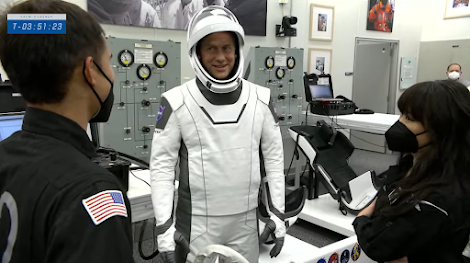
SpaceX Crew 3 Suiting Up

 Here are some photos from the Crew 3 pre-launch suit up taken from the SpaceX live feed.


The crew consists of Raja Chari, Thomas Marshburn, Matthias Maurer, and Kayla Barron.


Matthias Maurer and Kayla Barron


Thomas Marshburn


Raja Chari


Suit Room


Matthias Maurer and Kayla Barron

Kayla Barron

Matthias Maurer


Wednesday, November 3, 2021

Apollo Fashion Show

Aside from the bulky spacesuit (called a PGA, or Pressure Garment Assembly), an Apollo astronaut's wardrobe consisted of:

1. ICG: Inflight Coverall Garment

2. CWG: Constant Wear Garment (long johns)

3. BIG: Biological-Isolation Garment


Inflight Coverall Garment

This was a three-piece flight suit consisting of a jacket, trousers, and a pair of boots.

This was worn over the CWG whenever the astronauts were in a "shirtsleeve" environment (not wearing the pressure suit).

The first garments designed for Apollo flight were constructed of 4190B Beta cloth. But, to make them more durable, designers changed the material to Teflon-coated Beta cloth.

Astronauts reported discomfort caused by skin irritation, so designers added a Nomex lining to the jackets.

When the problem of skin irritation persisted, the material was again changed to woven Teflon fabric.


Apollo 12 astronauts (left to right) Conrad, Gordon, and Bean wearing ICG while preparing
for water egress training aboard the MV Retriever. Credit: NASA


Constant-Wear Garment

The CWG was a one-piece cotton-knit garment that covered the torso and feet, but left the lower arms bare.

It was designed to be worn next to the skin to provide warmth and absorb sweat.

Each astronaut had two of these garments.


Apollo training illustration of in-flight clothing items. Credit: NASA


Biological Isolation Garment

This was not worn in flight. It was designed to prevent astronauts from bringing moon germs (if any existed) back to contaminate Earth.

The BIG was a one-piece garment that included shoes, gloves, and hood.

Astronauts wore the isolation garments from splashdown to the recovery van.

It was made from a lightweight, high-density cotton fabric and required no special cooling equipment. Filters to screen out particles were provided in the BIG mask design.


Apollo 11 astronauts await the recovery helicopter with the
decontamination officer, all wearing BIGs. Credit: NASA


Source: NASA Technical Note TN D-6737, March 1972, 

Friday, October 15, 2021

Apollo 16 Mystery Debris

Mysteries abound in spaceflight, and when I see an official technical document with an astronaut quoted as saying "I don't know what they were, but they were there." it piques the interest.


L-R: Mattingly, Young, Duke during water egress training.  Source: NASA


The following comments were taken directly from "Apollo 16 Technical Crew Debriefing."


YOUNG is John Young, Apollo 16 Commander.

MATTINGLY is Ken Mattingly, Command Module Pilot.

DUKE is Charlie Duke, Lunar Module Pilot.

SLAYTON is Deke Slayton, Chief of the Astronaut Office.


DUKE It's a good idea to brace yourself. And, I was surprised with the debris that I caught out of my left eye as it came by the hatch window from the staging.

YOUNG Hey, that's another thing that you remarked on.

MATTINGLY Yes. That amazing.

YOUNG The debris was going right along with us.

MATTINGLY It was passing us. I don't understand that.

DUKE I think that was from retrofire.

MATTINGLY No, sir. This was during the powered flight steady state. There were particles; I looked out John's window and particles were going past us in the same direction. I kept looking at that; there's no way. But, it did it. I don't remember it on the S-I; but, I remember it on the S-II and the S-IV.

SLAYTON This wasn't during the staging sequence?

MATTINGLY No, sir. This was steady state, powered flight well after staging; and, I don't know where they came from. I don't know what they were, but they were there.

Source: "Apollo 16 Technical Crew Debriefing", May 5, 1972, https://www.hq.nasa.gov/alsj/a16/a16-techdebrief.pdf

Thursday, October 14, 2021

Cross-pollination in Space


I also write space fiction with a heavy real-science slant.  Today, I wanted to show an example and get a little cross-pollination going.

This "Ramone Rocketeer" post started out as a notion about visiting a fictional lunar gateway station, but it morphed into a discussion about partial pressures in breathing gasses...


"Here, Oleg and I are under the decontamination light at Lunar Gateway 5 . He was coming up and I was going down."


The full post is here: 


Thursday, September 30, 2021

Donning and Doffing


Gene Cernan, Apollo 17 commander.  Source: NASA

More info: https://www.hq.nasa.gov/alsj/a17/AS17Tech2.pdf


Astronaut Gene Cernan, commander of Apollo 17, commented about dressing ("donning") and undressing ("doffing") in the confined space of the Lunar Module.  But first, a vocabulary lesson.

LCG is a "Liquid Cooled Garment."  This was worn under the big moon suit.  It had small tubes sewn in to circulate water and keep the astronauts cool.  

CWG is a "Constant Wear Garment" like long-johns.

* * * * *

"When we doffed the suit, we went into a drying mode as the checklist suggests prior to the sleep period. I'm really glad we did because our suits stayed relatively fresh and clean on the inside.

We doffed our LCGs every day and slept in CWGs rather than the LCG. And I'm glad we did that because it was much more comfortable.

We made it a buddy system in the entire donning and prep when it came to the suit operations, except for putting on the gloves. We found it easier to put them on in parallel and get them locked and verified locked.

We actually, each individually in almost all cases, put our own glove dust covers and ring dust covers on. Maybe we had to help each other once in a while.

And contrary to some of our initial desires, we decided to go ahead and put those dust covers on for every EVA. After the first EVA, we found out what the dust problem really was."


[Excerpt from "Apollo 17 Technical Debrief, Manned Spacecraft Center Document MSC-07631" dated 4 January 1973.]

Wednesday, September 29, 2021

Apollo 16 "Invisible" Obstacles


More info: Apollo 16 Lunar Surface Journal; https://www.hq.nasa.gov/alsj/a16/a16.trvsta1.html

Lunar Roving Vehicle (LRV) gets a high-speed workout by Apollo 16 commander John Young. Source: NASA


When exploring the moon, Apollo astronauts visited several different "stations." These could be craters or other landmarks that looked interesting to scientists.

In the early missions, the astronauts walked to each station. Later, they had a cool moon buggy to drive.

John Young, the Apollo 16 commander, spent three days driving the Lunar Rover to distant stations, and he had some scary moments with "invisible" craters.  

After he returned to Earth in 1972, he met with engineers to discuss the mission and the worries he had about driving on the moon.

When Artemis astronauts return to the moon, this may be something to watch for...

* * * * *

"I was scared to go more than 4 or 5 kilometers an hour. Going out there, looking dead ahead, I couldn't see the craters. I could see the blocks alright and avoid them. But I couldn't see craters. I couldn't see benches. I was scared to go more than 4 or 5 clicks. Maybe some times I got up to 6 or 7, but I ran through a couple of craters because I flat missed (seeing) them until I was on top of them. And, I don't recommend driving in zero phase (which is the direction directly opposite the Sun). (Pre-flight) they kept saying they wanted it included in the traverse, and I specifically cautioned them not to include it on the traverse. But, there is no way for us to get to Flag Crater without driving in zero phase. It sure is grim. The other direction (on the way back to the LM) was about twice as good. I saw my tracks on the way back. We were doing 7, 8, 9, and 10 clicks. It wasn't any good during the traverses where we were going down-Sun. I was tacking a lot of times. But, when you got to a ridge, you couldn't tell if it was a drop-off, or whether it was a smooth, shallow ridge. In a couple of cases, you couldn't see there was a ridge. I didn't care for that much. It's kind of like landing an airplane aboard ship where you're looking right into the Sun and you can't see what you're doing. You just go ahead and land it anyway. It is not normal but, on occasion, you have to do it. But you'd just as soon not."

[Excerpt from the Apollo 16 Lunar Surface Journal with corrected transcript and commentary by Eric M. Jones (Copyright © 1997).]


Saturday, September 25, 2021

Eat Well Today

Your reminder to eat well today. 😄

Moonwalking Apollo astronauts had lots to accomplish in a short time.  To keep them on track, each astronaut had a little book strapped to the cuff of their spacesuit.  The book had reminders about the tasks they needed to finish in which order.

Sometimes, the checklist creators would add some humor.  The reminder below relates to a high-energy snack bar the astronauts could nibble while they worked.


Image: Apollo 16 moonwalk checklist worn on the spacesuit cuff
Source: Apollo Lunar Surface Journal https://www.hq.nasa.gov/alsj/alsj-DrinkFood.html


Apollo 16 moonwalker Charlie Duke said,

"That food stick was a thing that stuck inside the suit and it came up like this (on the right-hand side of the neck ring) and, when you were out on the surface, you could just reach over (with your teeth) and pull it up and chop off a piece. And it was really high-energy stuff."

Tuesday, September 21, 2021

Dress for Success

Ya know, they say to dress for the job you want. So I'm going to try that.


Saturday, September 4, 2021

Soyuz Ride

On 28 May 2014, ESA astronaut Alexander Gerst and NASA astronaut Reid Wiseman under the command of Russian cosmonaut Maxim Suraev rocketed into space in a Soyuz spacecraft. This was their voyage.


Source: European Space Agency, ESA