Showing posts with label asteroid. Show all posts

Thursday, November 11, 2021

Meteorite or Meteor-wrong?


I thought I had found some teeny meteorite fragments (see HERE), so I retraced my path along the same stretch of road.

Sure enough, my magnetic walking stick found some more magnetic grains. Some were smaller than before, but one was bigger. 

My most recent space rock candidates with a toothbrush for scale.


Maybe, I thought, the big one was big enough to grind a little to reveal the interior.

I'll call this big one "Biggie."

I used a nail file to scrape off some of the outer layer.


The Lunar and Planetary Institute recommends six tests to determine if a rock might be a meteorite. Here are the results on Biggie.

1. Does the sample have a black or brown surface? Yes
2. Is the sample solid, without pores or hollow vesicles? Yes
3. Is the sample heavy for its size? Not sure - too small to tell
4. If a corner of the sample is ground slightly, is the interior metallic silver? Yes - see below!
5. Is the sample unlike other rocks in the area? Yes
6. Is the sample magnetic? Yes


You can just begin to see a bright silver surface after light scraping.

Another view of the silver surface.


I passed 5 out of 6 tests. Maybe we have a winner? Stay tuned for more info as it becomes available.




Wednesday, November 10, 2021

Meteorite Hunter


I have started trying to find meteorites in my area.

It is amazing to think that I might be able to touch a planetary fragment that has drifted through space, unchanged for billions of years. 

Some meteorites may even be older than the Earth, or they might be blasted off of the moon or Mars!


Image: NASA; https://mars.nasa.gov/resources/21492/a-martian-meteorite-for-mars-2020/

I needed to know a lot more to be a good meteorite hunter, so I consulted The Lunar and Planetary Institute.

I learned it takes patience since meteorites are rare and sometimes tiny. I have been looking for iron meteorites using a walking stick with magnets taped near the tip.

My hand-carved walking stick with magnets taped near the tip.

David A. Kring wrote an article for The Lunar and Planetary Institute that says:
"Iron meteorites are much more common among the meteorite finds, because they are so unlike most terrestrial rocks and because stony meteorites are highly susceptible to weathering on the surface of the Earth."

Image: NASA; https://www2.jpl.nasa.gov/snc/nwa480.html

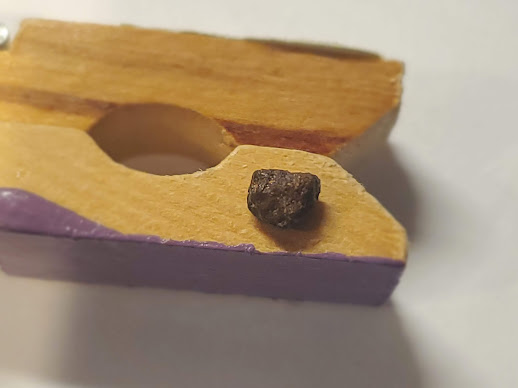
I recently found a tiny rock - a speck like a grain of rice - that stuck to my magnet. I wonder if it's a meteorite?  I put it on a clothespin to show the scale...


I checked my little rock using tests from The Lunar and Planetary Institute.

1. Does the sample have a black or brown surface? Yes
2. Is the sample solid, without pores or hollow vesicles? Yes
3. Is the sample heavy for its size? Not sure - too small to tell
4. If a corner of the sample is ground slightly, is the interior metallic silver? Too small to grind.
5. Is the sample unlike other rocks in the area? Yes
6. Is the sample magnetic? Yes


Here are some more photos of different sides.  One side is a little darker than the other.  Could it be from the reentry heating where one side got "cooked" more than the other?


Right now, it looks like it could be a tiny meteorite! I want to be sure, so stay tuned for more information if I can get someone to help identify it.


Tuesday, October 12, 2021

Lucy Art

More info: https://www.nasa.gov/mission_pages/lucy/overview/index

NASA is launching the Lucy Mission to explore some asteroids that travel in the same orbit as Jupiter. These are called Trojan asteroids, and they clump together in two regions: one is ahead of Jupiter, and one is behind.

I recently entered a NASA competition to "...illustrate the diversity that Lucy will explore by creating a work of art..."

Artists could use any medium, including painting, drawing, pottery, sculpture, 2D or 3D computer-generated products, music, film/video, written or spoken word, dance, or textile.

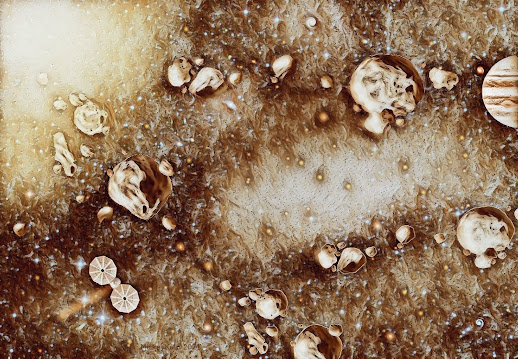
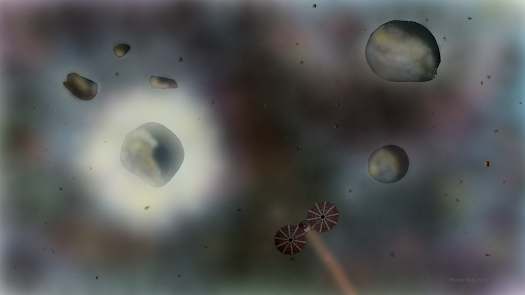
I created several versions of how I imagined Lucy would explore the Trojan asteroids, but I only submitted one.

Here are some others that I did not submit. Enjoy.


Thursday, September 16, 2021

Lucy Mission Art Challenge

If you are a space artist (like me - sorta), you might be interested in this opportunity...

"NASA’s Lucy Mission to the Trojan asteroids will survey eight asteroids in six independent orbits around the Sun to help unravel the history of the solar system. Your challenge is to illustrate the diversity Lucy will explore by creating a work of art in the medium of your choice, including, but not limited to painting, drawing, pottery, sculpture, 2D or 3D computer-generated products, music, film/video, written or spoken word, dance, or textile."


More Info: https://2021.spaceappschallenge.org/challenges/statements/artfully-illuminated-asteroids/details


Here is a sample that I created.  I have several versions, but this one is just for you!


Thursday, September 2, 2021

People Power!

"Citizen scientist" is a great title. It means regular people (like you and me) can help researchers make new discoveries.

You don't need any special training to make important discoveries. You need eyes and some examples to follow, then - BAM - you're exploring the universe!

Zooniverse is the world’s largest and most popular platform for people-powered research. They say this:

"You don’t need any specialized background, training, or expertise to participate in any Zooniverse projects. We make it easy for anyone to contribute to real academic research, on their own computer, at their own convenience."

Here are some of my favorite Zooniverse projects. 

Try them out and let me know what you think at MickeyKulp00 -at- gmail -dot- com.


*****

AI4Mars
Teaching Mars Rovers How to Classify Martian Terrain
https://www.zooniverse.org/projects/hiro-ono/ai4mars


*****

Active Asteroids
Examine images to find comet-like tails... on asteroids! These strange objects hold clues about water on Earth, in the solar system, and beyond.
https://www.zooniverse.org/projects/orionnau/active-asteroids


*****

Cosmological Jellyfish
Help us find galaxies that look like jellyfish! This will help us understand how they interact with their environment.
https://www.zooniverse.org/projects/apillepich/cosmological-jellyfish


*****

Dark Energy Explorers

Identify distant galaxies to help measure dark energy when the universe was just ~2-3 billion years old.
https://www.zooniverse.org/projects/erinmc/dark-energy-explorers


*****

Backyard Worlds: Planet 9
Search the realm beyond Neptune for new brown dwarfs and planets.
https://www.zooniverse.org/projects/marckuchner/backyard-worlds-planet-9