Showing posts with label mars. Show all posts

Wednesday, November 10, 2021

Meteorite Hunter


I have started trying to find meteorites in my area.

It is amazing to think that I might be able to touch a planetary fragment that has drifted through space, unchanged for billions of years. 

Some meteorites may even be older than the Earth, or they might be blasted off of the moon or Mars!


Image: NASA; https://mars.nasa.gov/resources/21492/a-martian-meteorite-for-mars-2020/

I needed to know a lot more to be a good meteorite hunter, so I consulted The Lunar and Planetary Institute.

I learned it takes patience since meteorites are rare and sometimes tiny. I have been looking for iron meteorites using a walking stick with magnets taped near the tip.

My hand-carved walking stick with magnets taped near the tip.

David A. Kring wrote an article for The Lunar and Planetary Institute that says:
"Iron meteorites are much more common among the meteorite finds, because they are so unlike most terrestrial rocks and because stony meteorites are highly susceptible to weathering on the surface of the Earth."

Image: NASA; https://www2.jpl.nasa.gov/snc/nwa480.html

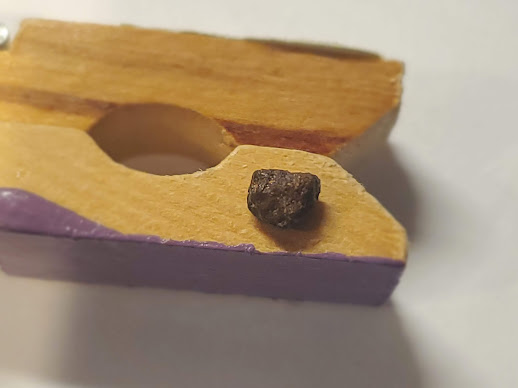
I recently found a tiny rock - a speck like a grain of rice - that stuck to my magnet. I wonder if it's a meteorite?  I put it on a clothespin to show the scale...


I checked my little rock using tests from The Lunar and Planetary Institute.

1. Does the sample have a black or brown surface? Yes
2. Is the sample solid, without pores or hollow vesicles? Yes
3. Is the sample heavy for its size? Not sure - too small to tell
4. If a corner of the sample is ground slightly, is the interior metallic silver? Too small to grind.
5. Is the sample unlike other rocks in the area? Yes
6. Is the sample magnetic? Yes


Here are some more photos of different sides.  One side is a little darker than the other.  Could it be from the reentry heating where one side got "cooked" more than the other?


Right now, it looks like it could be a tiny meteorite! I want to be sure, so stay tuned for more information if I can get someone to help identify it.


Friday, October 29, 2021

Star Life

For Outward Space visitors, I have curated a list of video lectures and presentations about astrobiology.

What is astrobiology?

Astrobiology means "star life." While we don't know for sure if life exists outside of Earth, G. Scott Hubbard, former director of NASA's Ames Research Center, says that astrobiology aims to embrace "the study of the origin, evolution, distribution and future of life in the universe."


Credit: "The Search for Life on Mars" by Dr. Janice Bishop,
Carl Sagan Center at the SETI Institute and the NASA Ames Research Center, February 9, 2010.


These videos are usually targeted for university-level audiences, but special background knowledge is not needed to understand them. Someone who is attentive can get lots of cool information.


Credit: "The Search for Life on Mars" by Dr. Janice Bishop,
Carl Sagan Center at the SETI Institute and the NASA Ames Research Center, February 9, 2010.


Playlist: https://www.youtube.com/playlist?list=PLu3189axKPkoqiDH6fALZh5XAIOEU2M_S

More about astrobiology: https://www.nasa.gov/feature/what-is-astrobiology


Credit: "The Search for Life on Mars" by Dr. Janice Bishop,
Carl Sagan Center at the SETI Institute and the NASA Ames Research Center, February 9, 2010.

Wednesday, October 13, 2021

AMADEE-20 is Making Mistakes on Mars


AMADEE-20 is a Mars analog simulation in the Negev Desert, Israel, managed by the Austrian Space Forum hosted by the Israeli Space Agency.

More info: https://oewf.org/en/amadee-20/

Before you do most important things, you practice. It works this way in sports, music, and missions to Mars. For missions to Mars, the practice time is called a simulation.

For twenty days (Oct 11 to 31, 2021) six researchers in the Negev Desert will simulate living on Mars in complete isolation from other humans.

The goal is to discover how to live and work safely on Mars. And to do that, the researchers hope to make lots of mistakes.

Yep.

Each mistake they make in the generally safe simulation means one less surprise in the harsh reality of Mars.

Dr. Gernot Grömer, Administrative Director of the Austrian Space Forum said the simulated mission "is designed to test concepts, working procedures and equipment to find the weak spots so the actual mission can be realized as safely as possible."

The six researchers, along with 200 others from 25 countries, plan to work on 20 different experiments to "prepare for future crewed missions on the Red Planet."

From left: Anika Mehlis, Carmen Köhler
(c) OeWF (Florian Voggeneder)


Thursday, September 2, 2021

People Power!

"Citizen scientist" is a great title. It means regular people (like you and me) can help researchers make new discoveries.

You don't need any special training to make important discoveries. You need eyes and some examples to follow, then - BAM - you're exploring the universe!

Zooniverse is the world’s largest and most popular platform for people-powered research. They say this:

"You don’t need any specialized background, training, or expertise to participate in any Zooniverse projects. We make it easy for anyone to contribute to real academic research, on their own computer, at their own convenience."

Here are some of my favorite Zooniverse projects. 

Try them out and let me know what you think at MickeyKulp00 -at- gmail -dot- com.


*****

AI4Mars
Teaching Mars Rovers How to Classify Martian Terrain
https://www.zooniverse.org/projects/hiro-ono/ai4mars


*****

Active Asteroids
Examine images to find comet-like tails... on asteroids! These strange objects hold clues about water on Earth, in the solar system, and beyond.
https://www.zooniverse.org/projects/orionnau/active-asteroids


*****

Cosmological Jellyfish
Help us find galaxies that look like jellyfish! This will help us understand how they interact with their environment.
https://www.zooniverse.org/projects/apillepich/cosmological-jellyfish


*****

Dark Energy Explorers

Identify distant galaxies to help measure dark energy when the universe was just ~2-3 billion years old.
https://www.zooniverse.org/projects/erinmc/dark-energy-explorers


*****

Backyard Worlds: Planet 9
Search the realm beyond Neptune for new brown dwarfs and planets.
https://www.zooniverse.org/projects/marckuchner/backyard-worlds-planet-9