Showing posts with label moon. Show all posts

Friday, December 17, 2021

Apollo Lunar Roving Vehicle: User's Guide

Apollo 15 Commander David Scott drives the lunar roving
vehicle on the surface of the Moon, the first time the rover
was used. Source: NASA


The Lunar Roving Vehicle (LRV) was an electric vehicle that allowed Apollo 15, 16, and 17 astronauts to drive on the Moon. It was folded up in the lunar module (LM) and deployed as show in in Image 1.

Image 1: Deployment sequence.
Source: Boeing Company

Astronauts were able to explore much more terrain with the rover.
 
The Apollo 15 astronauts drove a total of 27.8 km (17.3 miles) in 3 hours, 2 minutes of driving time.
 
The Apollo 16 astronauts traversed 26.7 km (16.6 miles) in 3 hours 26 minutes of driving.  Apollo 16 covered less distance in a longer time.  Note comments about visibility by Apollo 16's commander HERE.
 
The Apollo 17 astronauts went a whopping 35.9 km (22.3 miles) in 4 hours 26 minutes total drive time. At their farthest, the Apollo 17 astronauts were 7.6 km (4.7 miles) from the LM!


Image 2: Control and display console. 
Source: Boeing Company


The final cost of this amazing machine was $38 million. Four lunar rovers were built, one each for Apollos 15, 16, and 17, and one that was used for spare parts after the cancellation of further Apollo missions.

A 1-gravity trainer was also built to allow astronauts to practice driving.  They also trained to handle malfunctions.  Fortunately, the LRV operated just fine for all three missions.

Image 3: Example of one of many malfunction logic flow diagrams.
Source: Boeing Company


It took only 17 months to develop the LRV. Apollo 17's lunar module pilot Harrison Schmitt said,

"....the Lunar Rover proved to be the reliable, safe and flexible lunar exploration vehicle we expected it to be. Without it, the major scientific discoveries of Apollo 15, 16, and 17 would not have been possible..."


Image 4: When the steering dies, just pick up the rover to change direction! 
Source: Boeing Company


Sources:

[1] "Lunar Rover Operations Handbook"; Doc. LS006-002-2H; Boeing Company, LRV Systems Engineering; July 7, 1971; https://www.hq.nasa.gov/alsj/43944200-Lunar-Rover-Operations-Handbook-07071971.pdf

[2] "The Apollo Lunar Roving Vehicle"; https://nssdc.gsfc.nasa.gov/planetary/lunar/apollo_lrv.html


Wednesday, December 15, 2021

Apollo 14 Surface Navigation Problems

During their lunar exploration in 1971, Apollo 14 moonwalkers Alan B. Shepard Jr. and Edgar D. Mitchell had some unexpected problems navigating on the rugged surface.

Fifty years later, this conversation from their technical debriefing still has value for Artemis astronauts.

Alan Shepard assembles a double core tube as he stands beside the portable workbench or
modular equipment transporter (MET) unique to this mission during the
 second moon walk on Feb. 6, 1971. 
Credits: NASA/Edgar Mitchell


SHEPHARD

Until we really get a feel for navigation on the surface, there should be some strong check points to follow.

First of all, it gives you a feeling of security to know where you are. You know where you are distance-wise and what you have left to cover.

Second, there's no question in my mind that it's easy to misjudge distances, not only high above the surface -- that we discussed before -- but also distances along the surface.

It's so crystal clear up there -- there is no closeness that you try to associate with it in Earth terms -- it just looks a lot closer than it is.


Edgar Mitchell moves across the lunar surface as he looks over a traverse map during
exploration of Fra Mauro. Lunar dust can be seen clinging to the boots and legs of the
space suit. 
Credits: NASA/Alan Shepard

MITCHELL

I certainly agree with that. I think there are two problems that affect your distance measurements.

One, as Al described, and the second is there has to be a little bit of distortion in the bubble. I don't know how much that contributed to it, but I think it contributed some.

I believe that our primary problem in navigation was the surprise brought about by the roughness and the undulation of the terrain.

We couldn't see -- one set of landmarks, the prominent landmarks -- our next set of landmarks from our present position.

Large craters which we expected to be able to see standing out on a reasonably flat plane were not on a flat plane. They were hidden behind other craters, ridges, and old worn-down mounds.

You'd say , "Well, this next big crater ought to be a couple of hundred meters away, or 100 or 150 meters." It just wasn't anywhere in sight.

So you'd press on to another ridge and you still didn't see it. All you would see would be another ridge. Finally, you'd get over to it and there it was. You could not get enough perspective from any one spot to pin down precisely where you were.

...but that was kind of the feeling I had. I never knew what to expect when I went over the ridge of the sand dune or what I was going to see on the other side of it.

SHEPHARD

I think that complicated our problem. I don't know what to suggest on that.

I think that we have talked about navigation problems before. We always felt that you know you'd see these craters out here. Men have planned for them and they're very well defined and we ought to be able to locate them easily, but that just isn't the case.

There has to be more thought given to some better way of positioning oneself on the chart.


Source: "Apollo 14 Technical Crew Debriefing"; February 17, 1971; https://www.hq.nasa.gov/alsj/a14/a14-techdebrief.pdf


Tuesday, December 7, 2021

Hands on the Moon


In general, hand/arm fatigue is an ongoing problem for all astronauts when using their hands in a pressurized spacesuit. Imagine trying to squeeze a football for several hours over multiple days.

It can lead to finger, wrist, and arm pain including cramps and black fingernails.

Apollo missions were brief - 75 hours for the longest mission.  Now imagine you're an Artemis astronaut spending weeks in and out of a pressurized suit, not just a few days.


Gloves for the Apollo program were customized using plaster hand casts from each astronaut.
These are casts from Apollo 11 astronauts on display at the
US Space and Rocket Center in Huntsville, AL. Photo: Mickey Kulp


A rubber inner-glove was made from the plaster cast. 
The knuckles were artificially enlarged for easier bending. Photo: NASA

Dave Scott, the commander of Apollo 15, and Jim Irwin, lunar module pilot, spoke to reviewers in 1971 about their experiences using gloves in a pressurized suit on the moon. 

Scott's 50-year-old advice still has application for Artemis astronauts and designers.


Dave Scott making statements immediately after splashdown. 
Note his blackened fingernails. Photo: NASA

SCOTT

I ended up with a compromise solution on my arm length and my gloves. I had requested, just prior to the flight, for the people to shorten the arms so I could have mobility close to my chest, where I had to do most of the work.

If the arms were too long and the fingers were extended at that point, I got hand cramps trying to work the gloves. If the arms were shortened , when my arm was outstretched my fingers were pushing against the inside tips of the gloves.

My feeling before the flight was that I'd rather have the tight arms than the cramps in the hands. It resulted in too much pressure on my fingertips, but I'll accept that compromise because it enabled me to continue working without any hand cramps.

I never got any hand cramps at all throughout the whole operation. I felt like I had good mobility in cinching up the geology sample bags and in doing all that ALSEP [Apollo Lunar Surface Experiments Package] operation. Driving the Rover was also quite comfortable, except for my fingertips.

Other than that, I thought the PGA [Pressure Garment Assembly] was excellent.


Apollo 15 crew (L-R): CDR Dave Scott, CMP Al Worden, LMP Jim Irwin.  Photo: NASA


IRWIN

I think I had the same fit that you did on EVA-1, certainly. At the end of the EVA, my fingers were really sore -- the fingernails and the end of the fingers.

After that, I cut my fingernails back to the quick, just as far as I possibly could with the scissors; and then on EVA-2, my fingers didn't bother me at all . That solved it for me. I didn't have any cramps either.

Neil Armstrong's lunar glove from Apollo 11.  Photo: NASA.


SCOTT

I surely think that a better glove could be made which fits tighter. I think the gloves, in my case, are still too bulky, and there is too much easement inside the glove.

I think for an EVA operation you need to have a glove which has a smaller easement than for an IV [Intravehicular] operation when you don' t plan to pressurize. 

Scott gives some sound advice for our era of space exploration:

When you plan to run pressurized all the time, as you do an EVA glove, I think they should be designed and built for that operation alone, and not try to compromise by having it comfortable in an IV situation.

Neil Armstrong's lunar glove from Apollo 11.  Photo: NASA.


Further Reading

[1] "Apollo 15 Technical Crew Debriefing"; 14 AUG 1971; PDF scan by Glen Swanson; https://www.hq.nasa.gov/alsj/a15/a15tecdbrf.html

[2] "Neil Armstrong's Flown Suit"; https://www.hq.nasa.gov/alsj/a11/A11NAAFlownSuit.html


Saturday, December 4, 2021

Dick Gordon: Sleeping at the Moon

During Apollo missions to the moon, the command module pilot (CMP) stayed in lunar orbit while the two other astronauts landed and explored.


Dick Gordon was the CMP on the second moon landing mission, Apollo 12, in 1969.
Photo: NASA

After the mission, CMP Dick Gordon attended a debriefing in December 1969, and he had this to say about sleeping in space...

Sleep is probably an individual preference. I definitely had a preference for actually sleeping in the couch. I slept in the couch all but two nights.

These two nights, I slept in the sleeping bag underneath the number 1 couch, the left-hand couch. But it was always my preference to put the sleeping bag on, then get in the couch, and tie myself in the couch with a harness.

For some reason , I slept better with the lap belt and the shoulder harness on, and securely lashed down to the couch, rather than free floating or being suspended in the sleep restraint under the couch.

That was just a personal preference and it seemed to work better for me.

During sleep periods, I would wake up maybe two or three times. I would look around the spacecraft and make sure everything was okay and then really go back to sleep.

I got extremely tired at the end of that first day of lunar orbit activities. That sleep period was scheduled to be a relatively short one anyway. It necessarily turned out to be so because at the end of the day was the ... lunar orbit plane change number l occurred.

The CMP was alone in the command module during the lunar excursions. When his orbit went behind the moon, he was completely out of contact with every human everywhere. Gordon goes on to say:

But then I found that I had to do all the housekeeping and presleep activities by myself, whereas the 3 of us had been able to do them before and to clean them up in fairly rapid order.

It took a considerable length of time to wade through all that by myself, and this cut short the sleep period. So I actually was pretty tired in lunar orbit and didn't really catch up until one day out of lunar orbit on the way back.

I don't think anybody's performance was affected by fatigue and I'm not sure that fatigue really came into play. But certainly most of us in this particular occupation are used to performing while we are fatigued.


Source: "Apollo 12 Technical Crew Debriefing"; December 1, 1969; https://www.hq.nasa.gov/alsj/a12/a12-techdebrief.pdf

Wednesday, December 1, 2021

Apollo Docking Emergencies


Image: NASA


Apollo Lunar Orbit Rendezvous

During the Apollo moon landings in the 1960s and 1970s, two astronauts landed on the moon in the lunar module (LM). The third astronaut remained in lunar orbit in the command service module (CSM).

After the lunar mission was completed, the two moonwalkers would discard much of their unnecessary equipment (like their life support backpacks) and launch back into orbit.

But what would they do if the LM could not properly re-dock with the CSM?

Spacecraft Design

Both spacecraft had two doors. One was in the roof, and one was in the side.

The roof doors were where the two vehicles docked. The "tunnel" was the connection from the top of the CSM to the top of the LM.

When both craft were correctly docked, astronauts could travel easily between spacecraft using the tunnel.

But each spacecraft also had side doors. On the LM, the side door was where the astronauts came and went on the lunar surface. On the CSM, the side door was only used at launch and landing.

Later, on Apollo 15, 16, and 17, the side door was used when the command module pilot went outside to collect film canisters.

Image: NASA

Docking Failures

No docking failures were ever encountered in lunar orbit, but astronauts and mission planners gave it considerable thought.

The thinking revolved around two choices:

1. Transfer through the roof doors.
2. Transfer through the side doors.

Technical Debrief Discussion

In 1970, after successfully returning to Earth after a crippling explosion, the Apollo 13 crew discussed their thoughts on these choices with Deke Slayton (Chief of the Astronaut Office) and others.

The topic came up about "transfer from the LM to the CSM, if you were not properly docked."

LOVELL We did the WIF [Water Immersion Facility] exercise, and my feelings were that if we ever were faced with that in reality we were in deep trouble. As a matter of fact, we came up with a new technique.

HAISE We had several ways to go. You go through the tunnel or you could go outside. All we determined was that we couldn't make it through the tunnel.

LOVELL No, but we were trying to determine if we could use the PLSS [Portable Life Support System, backpack] from the lunar surface. Remember we wanted to leave the PLSSs on instead of taking them off.

HAISE We never had a PLSS on, in the water tank.

LOVELL Remember that late in the game we were talking about using a PLSS with John down at the Cape in the one-g mockup. I'm trying to see what the situation was that set us up so we could use that. We said instead of taking the PLSS off and putting the OPS [Oxygen Purge System] on.

HAISE We never did any training for that though. There was some idle conversation about that one day, because the hatch jammed and wouldn't seal. It was stuck in there and we couldn't pressurize the LM.

LOVELL Yes, but the normal thing was to get rid of the PLSS.

HAISE Yes. Do a vacuum mate/demate.

LOVELL I think you would be much better off to leave the PLSS on and do the EVT [Extravehicular Transfer] with the PLSS, because you would have communications and you wouldn't have to do all that vacuum demating and mating and get all that stuff squared away.

HAISE You never get even one-g, on the ascent stage. Why don't you just lift off with the PLSS on your back, and go into orbit that way?

SLAYTON It depends entirely on what your failure mode is. Even in that case, if you get docked, you can get repress from the CSM and get back to normal, anyway.

LOVELL We were looking at the case where we had no LM pressurization, and, we couldn't go to the tunnel. We had to go exterior.

We thought that we could even recharge our PLSS with the LM system under vacuum conditions, better than we could take off the PLSS, put on the OPS, and pressurize.

We were willing to launch with the PLSS on our back and transfer that way, because we would have communications that way. It would take a long time, maybe 4 hours to recharge the PLSS. That was the only change we had on that.


Diagram from Apollo 10 debriefing transcript showing the EVA that would be route taken to
transfer from the LM to the CM should the docking tunnel not be usable. Source: NASA


Sources:

[1] "Apollo 13 Technical Debrief"; 24 April 1970; PDF by Glen Swanson; https://www.hq.nasa.gov/alsj/a13/a13-techdebrief.pdf

[2] "Apollo Oxygen Purge System (OPS) for the Portable Life Support System (PLSS) & Extravehicular Mobility Unit (EMU)"; Karl Dodenhoff; https://www.hq.nasa.gov/alsj/alsj-OPS.html

[3] "Apollo 10 Day 5, part 17: Snoopy prepares for the main event"; Corrected Transcript and Commentary Copyright © 2012-2021 by W. David Woods, Robin Wheeler and Ian Roberts; https://history.nasa.gov/afj/ap10fj/as10-day5-pt17.html

Wednesday, November 10, 2021

Meteorite Hunter


I have started trying to find meteorites in my area.

It is amazing to think that I might be able to touch a planetary fragment that has drifted through space, unchanged for billions of years. 

Some meteorites may even be older than the Earth, or they might be blasted off of the moon or Mars!


Image: NASA; https://mars.nasa.gov/resources/21492/a-martian-meteorite-for-mars-2020/

I needed to know a lot more to be a good meteorite hunter, so I consulted The Lunar and Planetary Institute.

I learned it takes patience since meteorites are rare and sometimes tiny. I have been looking for iron meteorites using a walking stick with magnets taped near the tip.

My hand-carved walking stick with magnets taped near the tip.

David A. Kring wrote an article for The Lunar and Planetary Institute that says:
"Iron meteorites are much more common among the meteorite finds, because they are so unlike most terrestrial rocks and because stony meteorites are highly susceptible to weathering on the surface of the Earth."

Image: NASA; https://www2.jpl.nasa.gov/snc/nwa480.html

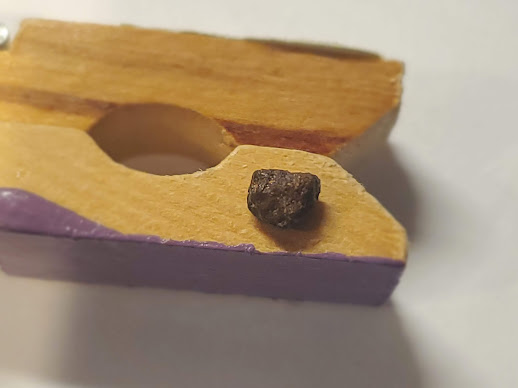
I recently found a tiny rock - a speck like a grain of rice - that stuck to my magnet. I wonder if it's a meteorite?  I put it on a clothespin to show the scale...


I checked my little rock using tests from The Lunar and Planetary Institute.

1. Does the sample have a black or brown surface? Yes
2. Is the sample solid, without pores or hollow vesicles? Yes
3. Is the sample heavy for its size? Not sure - too small to tell
4. If a corner of the sample is ground slightly, is the interior metallic silver? Too small to grind.
5. Is the sample unlike other rocks in the area? Yes
6. Is the sample magnetic? Yes


Here are some more photos of different sides.  One side is a little darker than the other.  Could it be from the reentry heating where one side got "cooked" more than the other?


Right now, it looks like it could be a tiny meteorite! I want to be sure, so stay tuned for more information if I can get someone to help identify it.


Wednesday, November 3, 2021

Apollo Fashion Show

Aside from the bulky spacesuit (called a PGA, or Pressure Garment Assembly), an Apollo astronaut's wardrobe consisted of:

1. ICG: Inflight Coverall Garment

2. CWG: Constant Wear Garment (long johns)

3. BIG: Biological-Isolation Garment


Inflight Coverall Garment

This was a three-piece flight suit consisting of a jacket, trousers, and a pair of boots.

This was worn over the CWG whenever the astronauts were in a "shirtsleeve" environment (not wearing the pressure suit).

The first garments designed for Apollo flight were constructed of 4190B Beta cloth. But, to make them more durable, designers changed the material to Teflon-coated Beta cloth.

Astronauts reported discomfort caused by skin irritation, so designers added a Nomex lining to the jackets.

When the problem of skin irritation persisted, the material was again changed to woven Teflon fabric.


Apollo 12 astronauts (left to right) Conrad, Gordon, and Bean wearing ICG while preparing
for water egress training aboard the MV Retriever. Credit: NASA


Constant-Wear Garment

The CWG was a one-piece cotton-knit garment that covered the torso and feet, but left the lower arms bare.

It was designed to be worn next to the skin to provide warmth and absorb sweat.

Each astronaut had two of these garments.


Apollo training illustration of in-flight clothing items. Credit: NASA


Biological Isolation Garment

This was not worn in flight. It was designed to prevent astronauts from bringing moon germs (if any existed) back to contaminate Earth.

The BIG was a one-piece garment that included shoes, gloves, and hood.

Astronauts wore the isolation garments from splashdown to the recovery van.

It was made from a lightweight, high-density cotton fabric and required no special cooling equipment. Filters to screen out particles were provided in the BIG mask design.


Apollo 11 astronauts await the recovery helicopter with the
decontamination officer, all wearing BIGs. Credit: NASA


Source: NASA Technical Note TN D-6737, March 1972, 

Thursday, October 28, 2021

"It's just gone."


Edgar Mitchell moves across the lunar surface as he looks over a traverse 
map while exploring the Fra Mauro regionCredit: NASA/Alan Shepard

I have been studying the technical details of lunar exploration for a while now.  I think the archives have important information that will help Artemis explorers and mission planners.

While reading through the "Apollo 14 Technical Crew Debriefing" from 1971, I found some interesting comments from lunar module pilot Ed Mitchell about visibility on the lunar surface.

"In looking out the window from the LM [Lunar Module], I had a very definite impression of the relief. I think we stated several times that the relief was greater than we expected. However, I observed that when we got on the lunar surface, subsequent to that, that your observation of the relief changes with Sun angle.
The Sun wipes out, or seems to smooth out, a lot of relief that you see at certain Sun angles and that you just don't see at other Sun angles. Or maybe the visor distorts it in some way. But sometimes you see a very good sized, crater, a depression ahead of you. You look at it at a different angle and it's just gone.
When you turn your head a different way, you don't see it. So, perhaps there's a bit of distortion in the visors. You're never quite sure whether it's visor distortion or whether it's Sun angle or what it is that causes you to see these things or not to see them at a particular point in time."
Source: Apollo 14 Technical Crew Debriefing, February 17, 1971, https://www.hq.nasa.gov/alsj/a14/a14-techdebrief.pdf


This aligns with similar startling observations from Apollo 16 commander John Young posted here: https://outwardspace.blogspot.com/2021/09/apollo-16-invisible-obstacles.html

Visibility issues related to a combination of sun angle and/or visor distortion may pose a hazard to future lunar explorers.  

Depending on the landing site, a mission lasting one lunar day (about 30 Earth days) will expose Artemis astronauts to every possible sun angle, including possible weeks of darkness.


Wednesday, October 20, 2021

Life on Europa?


Europa, a moon of Jupiter, is starting to look like a place we could find living organisms! Image that!

But, we have to go there and look to know for sure. 


Europa.  Credit: NASA

At the dark, cold bottom of Earth's oceans we find life around hydrothermal vents

Hydrothermal vents are places where hot sea water blasts up through the seafloor back into the ocean - like an underwater geyser full of minerals.

If we can find evidence for hydrothermal vents on Europa, maybe we can find life around them too.

NASA's Jet Propulsion Laboratory says:

With evidence of a global ocean underneath an active, icy crust, Europa has become an increasingly intriguing destination in the search for life beyond Earth. Future NASA missions will explore Europa and other ocean worlds.


Video lecture featuring planetary geologist Cynthia Phillips. Credit:  NASA JPL 

Thursday, October 14, 2021

Cross-pollination in Space


I also write space fiction with a heavy real-science slant.  Today, I wanted to show an example and get a little cross-pollination going.

This "Ramone Rocketeer" post started out as a notion about visiting a fictional lunar gateway station, but it morphed into a discussion about partial pressures in breathing gasses...


"Here, Oleg and I are under the decontamination light at Lunar Gateway 5 . He was coming up and I was going down."


The full post is here: 


Sunday, October 3, 2021

Moon Secrets Inches Away


Apollo 12 lunar module pilot Alan Bean with commander Pete Conrad reflected in his visor. Credit: NASA


More info: https://www.hq.nasa.gov/alsj/a12/a12-techdebrief.pdf

Apollo 12 astronaut Alan Bean - who was also a fine artist - had some advice in 1969 for future lunar explorers who will be uncovering the moon's secrets...

* * * * *

The entire lunar surface was covered with this mantle of broken up material, fine dust of varying depth. As a result, everything looked pretty much the same - sides of the craters, tops of the craters, flat lands, and ejecta blanket.

If you're going to do any geology, you're going to have to dig through this mantle of brown or black and to look beneath the surface a little bit. We had a shovel that we used for trenching, but because of the length of the extension handle and the inability to lean over and what have you, we never could trench more than about eight inches. That was about the best we could do, and that was a pretty big effort.

If we're going to do any good geology, it's going to take a lot of trenching to get down below the surface. I'd like to recommend that we get a better trenching tool.

Maybe all we need to do is lengthen the extension handle about six inches; but if we're going to look and see what's beneath the surface, we're going to have to dig it out of there somehow.

...I felt that, on the surface everything was pretty much the same and the real secrets were hiding about two to eight inches under the surface.


[Excerpt from "Apollo 12 Technical Crew Debriefing", December 1, 1969. Source: NASA]


Thursday, September 30, 2021

Donning and Doffing


Gene Cernan, Apollo 17 commander.  Source: NASA

More info: https://www.hq.nasa.gov/alsj/a17/AS17Tech2.pdf


Astronaut Gene Cernan, commander of Apollo 17, commented about dressing ("donning") and undressing ("doffing") in the confined space of the Lunar Module.  But first, a vocabulary lesson.

LCG is a "Liquid Cooled Garment."  This was worn under the big moon suit.  It had small tubes sewn in to circulate water and keep the astronauts cool.  

CWG is a "Constant Wear Garment" like long-johns.

* * * * *

"When we doffed the suit, we went into a drying mode as the checklist suggests prior to the sleep period. I'm really glad we did because our suits stayed relatively fresh and clean on the inside.

We doffed our LCGs every day and slept in CWGs rather than the LCG. And I'm glad we did that because it was much more comfortable.

We made it a buddy system in the entire donning and prep when it came to the suit operations, except for putting on the gloves. We found it easier to put them on in parallel and get them locked and verified locked.

We actually, each individually in almost all cases, put our own glove dust covers and ring dust covers on. Maybe we had to help each other once in a while.

And contrary to some of our initial desires, we decided to go ahead and put those dust covers on for every EVA. After the first EVA, we found out what the dust problem really was."


[Excerpt from "Apollo 17 Technical Debrief, Manned Spacecraft Center Document MSC-07631" dated 4 January 1973.]

Wednesday, September 29, 2021

Apollo 16 "Invisible" Obstacles


More info: Apollo 16 Lunar Surface Journal; https://www.hq.nasa.gov/alsj/a16/a16.trvsta1.html

Lunar Roving Vehicle (LRV) gets a high-speed workout by Apollo 16 commander John Young. Source: NASA


When exploring the moon, Apollo astronauts visited several different "stations." These could be craters or other landmarks that looked interesting to scientists.

In the early missions, the astronauts walked to each station. Later, they had a cool moon buggy to drive.

John Young, the Apollo 16 commander, spent three days driving the Lunar Rover to distant stations, and he had some scary moments with "invisible" craters.  

After he returned to Earth in 1972, he met with engineers to discuss the mission and the worries he had about driving on the moon.

When Artemis astronauts return to the moon, this may be something to watch for...

* * * * *

"I was scared to go more than 4 or 5 kilometers an hour. Going out there, looking dead ahead, I couldn't see the craters. I could see the blocks alright and avoid them. But I couldn't see craters. I couldn't see benches. I was scared to go more than 4 or 5 clicks. Maybe some times I got up to 6 or 7, but I ran through a couple of craters because I flat missed (seeing) them until I was on top of them. And, I don't recommend driving in zero phase (which is the direction directly opposite the Sun). (Pre-flight) they kept saying they wanted it included in the traverse, and I specifically cautioned them not to include it on the traverse. But, there is no way for us to get to Flag Crater without driving in zero phase. It sure is grim. The other direction (on the way back to the LM) was about twice as good. I saw my tracks on the way back. We were doing 7, 8, 9, and 10 clicks. It wasn't any good during the traverses where we were going down-Sun. I was tacking a lot of times. But, when you got to a ridge, you couldn't tell if it was a drop-off, or whether it was a smooth, shallow ridge. In a couple of cases, you couldn't see there was a ridge. I didn't care for that much. It's kind of like landing an airplane aboard ship where you're looking right into the Sun and you can't see what you're doing. You just go ahead and land it anyway. It is not normal but, on occasion, you have to do it. But you'd just as soon not."

[Excerpt from the Apollo 16 Lunar Surface Journal with corrected transcript and commentary by Eric M. Jones (Copyright © 1997).]


Saturday, September 25, 2021

Eat Well Today

Your reminder to eat well today. 😄

Moonwalking Apollo astronauts had lots to accomplish in a short time.  To keep them on track, each astronaut had a little book strapped to the cuff of their spacesuit.  The book had reminders about the tasks they needed to finish in which order.

Sometimes, the checklist creators would add some humor.  The reminder below relates to a high-energy snack bar the astronauts could nibble while they worked.


Image: Apollo 16 moonwalk checklist worn on the spacesuit cuff
Source: Apollo Lunar Surface Journal https://www.hq.nasa.gov/alsj/alsj-DrinkFood.html


Apollo 16 moonwalker Charlie Duke said,

"That food stick was a thing that stuck inside the suit and it came up like this (on the right-hand side of the neck ring) and, when you were out on the surface, you could just reach over (with your teeth) and pull it up and chop off a piece. And it was really high-energy stuff."

Thursday, September 23, 2021

International Observe the Moon Night


More info: https://moon.nasa.gov/observe-the-moon-night/

From NASA...

When you look up in the sky at night, often the brightest object you can see is our Moon! Earth only has one Moon. So, no matter where you are on Earth, the Moon you see is the same one that everyone else sees. But, every person’s view of that same Moon is a little bit different!

Why not check out what the Moon looks like from where you live? You can join others around the world in a night of Moon watching on October 16, for International Observe the Moon Night! 

This is some moon art from my Rocket Team science fiction blog at https://ramonerocketeer.blogspot.com/


Wednesday, September 22, 2021

September Space Art Challenge

Deadline: September 30, 2021

More info: https://spaceplace.nasa.gov/art-challenge/en/

From NASA...

September’s drawing prompt:

This month’s art prompt: Draw a view of the Moon on Halloween night! Is the Moon helping to light the way for trick-or-treaters? Can you spot the Moon above your neighborhood Halloween decorations?

Hint: This Halloween, the Moon will be in the waning crescent phase. Check out our page on the Moon’s phases to learn more about what this means.

Submit your drawings between 9/2/21 and 9/30/21. Selected art submissions will appear on the website during the first week of October!


This is some moon art I created for the Rocket Team series of science fiction books.
You can see more at https://ramonerocketeer.blogspot.com/


Wednesday, September 8, 2021

Your Mission: Find a Lunar Landing Site


The Artemis mission planners need your help. When we go back to the moon in the next few years, where should we land?

Your job is to review five different places and decide where we should build an outpost.

These places are:

1. Highlands
2. South Pole
3. Aristarchus
4. Tranquility
5. Far Eastern


You rate each place based on these factors:

1. Water and Resources
Can be used for water and fuel. May occur as ice on the Moon, delivered by comets and maintained in Permanently Shadowed Regions (PSRs) near the poles.

Batteries are heavy payload to send to the Moon. Solar power will be a primary source. Fuel could come from the break down of water ice into oxygen and hydrogen.

Aluminum, titanium, iron, loose lunar regolith to make “lunar bricks” all offer building resources.

2. Terrain Smoothness (Topography)
Flat terrain is best, not near steep cliffs, mountainous regions or areas with lots of boulders.

3. Temperature and 4. Radiation
Natural habitats or resources, such as lava tubes (ancient caves created where lava once flowed) or soil to cover a base or make lunar bricks, offer protection from radiation and extreme temperatures. If not available, a base will need to be built.

5. Science
What are the interesting science questions to be addressed?

6. Special Considerations
Needs a clear line of sight to Earth, or a more costly satellite system will be needed.


Use a grid and fill in the squares with "Go", "No Go", or "Need Info"


Tuesday, September 7, 2021

Landing on the Moon

When a crew capsule lands on the Earth, it slows down by using parachutes to grab the thick blanket of air in our sky.

But, when a crew capsule (or a robot) lands on the moon, there is no air to grab. A parachute is useless.

The Apollo 12 lunar module, Intrepid, ready to land on Nov. 19, 1969.
Credits: NASA/Richard Gordon


So, to safely land on the moon, we have to use thrust to slow down. This video shows how you can experiment with thrust to build your own moon lander.


Friday, September 3, 2021

Water on the Moon?

Scientists have discovered that water is being released from the Moon during meteor showers. 

When a speck of comet debris strikes the Moon it vaporizes on impact, creating a shock wave in the lunar soil. For a sufficiently large impactor, this shock wave can breach the soil's dry upper layer and release water molecules from a hydrated layer below.

Source: NASA