Friday, October 29, 2021

Star Life

For Outward Space visitors, I have curated a list of video lectures and presentations about astrobiology.

What is astrobiology?

Astrobiology means "star life." While we don't know for sure if life exists outside of Earth, G. Scott Hubbard, former director of NASA's Ames Research Center, says that astrobiology aims to embrace "the study of the origin, evolution, distribution and future of life in the universe."


Credit: "The Search for Life on Mars" by Dr. Janice Bishop,
Carl Sagan Center at the SETI Institute and the NASA Ames Research Center, February 9, 2010.


These videos are usually targeted for university-level audiences, but special background knowledge is not needed to understand them. Someone who is attentive can get lots of cool information.


Credit: "The Search for Life on Mars" by Dr. Janice Bishop,
Carl Sagan Center at the SETI Institute and the NASA Ames Research Center, February 9, 2010.


Playlist: https://www.youtube.com/playlist?list=PLu3189axKPkoqiDH6fALZh5XAIOEU2M_S

More about astrobiology: https://www.nasa.gov/feature/what-is-astrobiology


Credit: "The Search for Life on Mars" by Dr. Janice Bishop,
Carl Sagan Center at the SETI Institute and the NASA Ames Research Center, February 9, 2010.

Thursday, October 28, 2021

"It's just gone."


Edgar Mitchell moves across the lunar surface as he looks over a traverse 
map while exploring the Fra Mauro regionCredit: NASA/Alan Shepard

I have been studying the technical details of lunar exploration for a while now.  I think the archives have important information that will help Artemis explorers and mission planners.

While reading through the "Apollo 14 Technical Crew Debriefing" from 1971, I found some interesting comments from lunar module pilot Ed Mitchell about visibility on the lunar surface.

"In looking out the window from the LM [Lunar Module], I had a very definite impression of the relief. I think we stated several times that the relief was greater than we expected. However, I observed that when we got on the lunar surface, subsequent to that, that your observation of the relief changes with Sun angle.
The Sun wipes out, or seems to smooth out, a lot of relief that you see at certain Sun angles and that you just don't see at other Sun angles. Or maybe the visor distorts it in some way. But sometimes you see a very good sized, crater, a depression ahead of you. You look at it at a different angle and it's just gone.
When you turn your head a different way, you don't see it. So, perhaps there's a bit of distortion in the visors. You're never quite sure whether it's visor distortion or whether it's Sun angle or what it is that causes you to see these things or not to see them at a particular point in time."
Source: Apollo 14 Technical Crew Debriefing, February 17, 1971, https://www.hq.nasa.gov/alsj/a14/a14-techdebrief.pdf


This aligns with similar startling observations from Apollo 16 commander John Young posted here: https://outwardspace.blogspot.com/2021/09/apollo-16-invisible-obstacles.html

Visibility issues related to a combination of sun angle and/or visor distortion may pose a hazard to future lunar explorers.  

Depending on the landing site, a mission lasting one lunar day (about 30 Earth days) will expose Artemis astronauts to every possible sun angle, including possible weeks of darkness.


Wednesday, October 27, 2021

Jupiter's Harsh Radiation


I was reading about the radiation environment at Jupiter, and it made me think about a future crewed mission to the gas giant.

Jupiter taken by Juno.  Credit: NASA

Some planets have magnetic fields that trap and re-direct charged particles from the sun into intense radiation belts.

Earth has the Van Allen belts, and Apollo lunar missions in the 1960's and 1970's had to find safe ways through them. But, Jupiter's radiation is way stronger...

"Well below the Jovian cloud tops is a layer of hydrogen under such incredible pressure it acts as an electrical conductor. Scientists believe that the combination of this metallic hydrogen along with Jupiter’s fast rotation — one day on Jupiter is only 10 hours long — generates a powerful magnetic field that surrounds the planet with electrons, protons and ions traveling at nearly the speed of light. Any spacecraft that enters this field of high-energy particles encounters the harshest radiation environment in the solar system."
Source: "Juno Mission to Jupiter: June 23 Lecture With Dr. Jack Connerney", June 20, 2016, by Ellen Terrell

So I imagined a future time when astronauts would have to take precautions like living on a base far from Jupiter and using special gear when traveling near Jupiter.

All this study about Jupiter and radiation got my space fiction juices flowing, and I created this Ramone Rocketeer post: https://ramonerocketeer.blogspot.com/2021/10/the-hazards-of-jupiter.html


Art from "The Hazards of Jupiter" by Mickey Kulp


Saturday, October 23, 2021

Space Fiction: "It was my goof."

This is from my space fiction blog. It has historical information about Apollo 8 you might like.

"Mick made a mistake recently. While we were talking on his way to Lunar Gateway 5,
he was fooling around doing somersaults in zero G and bumped a switch."


More here: https://ramonerocketeer.blogspot.com/2021/10/it-was-my-goof.html


The Apollo 8 historical information is from:

[1] "Apollo 8: The Thrilling Story of the First Mission to the Moon" by Jeffrey Kluger; 

[2] "The Apollo 8 Flight Journal" section "Day 5: The Green Team" by David Woods and Frank O'Brien; https://history.nasa.gov/afj/ap08fj/24day5_green.html

Wednesday, October 20, 2021

Life on Europa?


Europa, a moon of Jupiter, is starting to look like a place we could find living organisms! Image that!

But, we have to go there and look to know for sure. 


Europa.  Credit: NASA

At the dark, cold bottom of Earth's oceans we find life around hydrothermal vents

Hydrothermal vents are places where hot sea water blasts up through the seafloor back into the ocean - like an underwater geyser full of minerals.

If we can find evidence for hydrothermal vents on Europa, maybe we can find life around them too.

NASA's Jet Propulsion Laboratory says:

With evidence of a global ocean underneath an active, icy crust, Europa has become an increasingly intriguing destination in the search for life beyond Earth. Future NASA missions will explore Europa and other ocean worlds.


Video lecture featuring planetary geologist Cynthia Phillips. Credit:  NASA JPL 

Tuesday, October 19, 2021

Planetary Art

I enjoy creating art on a computer and with real paint.  

Below are some fanciful exoplanets I painted recently.

An exoplanet is a planet that is outside our solar system.  No one has seen a real exoplanet yet, but I have some guesses about how some of them look.


I made some mistakes on this one, but it's ok.  I fixed them later.


I painted these on poster boards.  You don't have to spend a lot of money on canvases.


These planets orbit near a black hole.


These planets are hanging on my wall in my basement.

I also post art and other space topics here: https://www.facebook.com/RamoneRocketeer

Monday, October 18, 2021

Orionid Meteor Shower


Credit: NASA


We see meteors (also called shooting stars) in the sky whenever Earth travels through an area of space littered with debris from a past comet.

Orionid meteors appear every year in mid-October when Earth plows through the dusty trail left over from Halley's comet.

QUESTION: Shouldn't they be called "Halley meteors" instead?

ANSWER: Good idea, but no. Meteor showers are named after their "radiant." This is the part of the sky from which the meteors appear to radiate or spread out from.

The Orionid meteors appear to radiate from the constellation Orion.

QUESTION: Shouldn't they be called "Orion meteors" instead of "Orionid meteors"?

ANSWER: Probably, but scientists like to use fancy Latin words.

Comet Halley takes about 76 years to orbit the sun. Each time it crosses Earth's orbit, it leaves more dust and rocks behind for us to run into year after year.

Fun fact: I saw Halley's comet the last time it came around in 1986. I only had a small telescope, so it did not look very impressive, sad to say.

But don't worry. Comet Halley will swing through the inner solar system again in 2061, a measly 40 years from now.  Maybe you will see it for yourself.

Back to the meteors!  NASA has these viewing tips...

"The Orionids are viewable in both the Northern and Southern hemispheres during the hours after midnight. Find an area well away from city or street lights. Come prepared with a sleeping bag, blanket or lawn chair.
Lie flat on your back with your feet facing southeast if you are in the Northern Hemisphere or northeast if you are in the Southern Hemisphere, and look up, taking in as much of the sky as possible. In less than 30 minutes in the dark, your eyes will adapt and you will begin to see meteors.
Be patient -- the show will last until dawn, so you have plenty of time to catch a glimpse."


More info: https://solarsystem.nasa.gov/asteroids-comets-and-meteors/meteors-and-meteorites/orionids/in-depth/


Saturday, October 16, 2021

Shenzhou 13


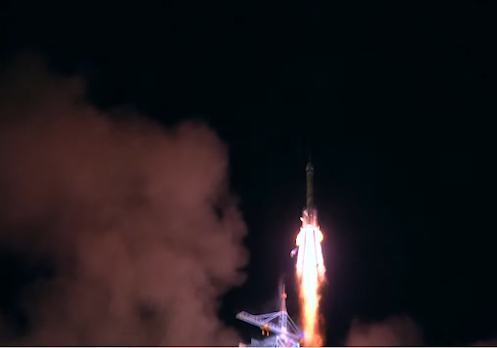
On October 15, 2021, the Shenzhou 13 spacecraft carried Chinese astronauts Zhai Zhigang (commander), Wang Yaping, and Ye Guangfu into orbit. They will dock with the Tianhe space station and live aboard for six months.

Full video here: https://youtu.be/-xcTjosgtfE

Images below are from the launch coverage from Space.com.


Friday, October 15, 2021

Apollo 16 Mystery Debris

Mysteries abound in spaceflight, and when I see an official technical document with an astronaut quoted as saying "I don't know what they were, but they were there." it piques the interest.


L-R: Mattingly, Young, Duke during water egress training.  Source: NASA


The following comments were taken directly from "Apollo 16 Technical Crew Debriefing."


YOUNG is John Young, Apollo 16 Commander.

MATTINGLY is Ken Mattingly, Command Module Pilot.

DUKE is Charlie Duke, Lunar Module Pilot.

SLAYTON is Deke Slayton, Chief of the Astronaut Office.


DUKE It's a good idea to brace yourself. And, I was surprised with the debris that I caught out of my left eye as it came by the hatch window from the staging.

YOUNG Hey, that's another thing that you remarked on.

MATTINGLY Yes. That amazing.

YOUNG The debris was going right along with us.

MATTINGLY It was passing us. I don't understand that.

DUKE I think that was from retrofire.

MATTINGLY No, sir. This was during the powered flight steady state. There were particles; I looked out John's window and particles were going past us in the same direction. I kept looking at that; there's no way. But, it did it. I don't remember it on the S-I; but, I remember it on the S-II and the S-IV.

SLAYTON This wasn't during the staging sequence?

MATTINGLY No, sir. This was steady state, powered flight well after staging; and, I don't know where they came from. I don't know what they were, but they were there.

Source: "Apollo 16 Technical Crew Debriefing", May 5, 1972, https://www.hq.nasa.gov/alsj/a16/a16-techdebrief.pdf

Thursday, October 14, 2021

Cross-pollination in Space


I also write space fiction with a heavy real-science slant.  Today, I wanted to show an example and get a little cross-pollination going.

This "Ramone Rocketeer" post started out as a notion about visiting a fictional lunar gateway station, but it morphed into a discussion about partial pressures in breathing gasses...


"Here, Oleg and I are under the decontamination light at Lunar Gateway 5 . He was coming up and I was going down."


The full post is here: 


Wednesday, October 13, 2021

AMADEE-20 is Making Mistakes on Mars


AMADEE-20 is a Mars analog simulation in the Negev Desert, Israel, managed by the Austrian Space Forum hosted by the Israeli Space Agency.

More info: https://oewf.org/en/amadee-20/

Before you do most important things, you practice. It works this way in sports, music, and missions to Mars. For missions to Mars, the practice time is called a simulation.

For twenty days (Oct 11 to 31, 2021) six researchers in the Negev Desert will simulate living on Mars in complete isolation from other humans.

The goal is to discover how to live and work safely on Mars. And to do that, the researchers hope to make lots of mistakes.

Yep.

Each mistake they make in the generally safe simulation means one less surprise in the harsh reality of Mars.

Dr. Gernot Grömer, Administrative Director of the Austrian Space Forum said the simulated mission "is designed to test concepts, working procedures and equipment to find the weak spots so the actual mission can be realized as safely as possible."

The six researchers, along with 200 others from 25 countries, plan to work on 20 different experiments to "prepare for future crewed missions on the Red Planet."

From left: Anika Mehlis, Carmen Köhler
(c) OeWF (Florian Voggeneder)


Tuesday, October 12, 2021

Lucy Art

More info: https://www.nasa.gov/mission_pages/lucy/overview/index

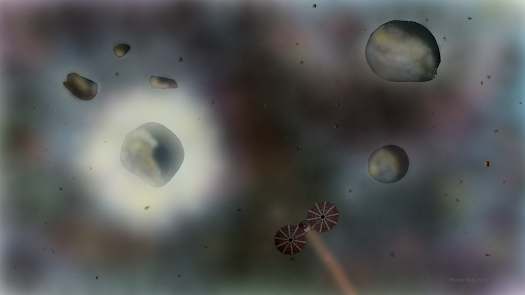
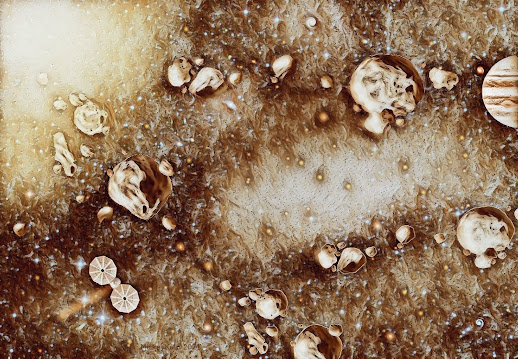
NASA is launching the Lucy Mission to explore some asteroids that travel in the same orbit as Jupiter. These are called Trojan asteroids, and they clump together in two regions: one is ahead of Jupiter, and one is behind.

I recently entered a NASA competition to "...illustrate the diversity that Lucy will explore by creating a work of art..."

Artists could use any medium, including painting, drawing, pottery, sculpture, 2D or 3D computer-generated products, music, film/video, written or spoken word, dance, or textile.

I created several versions of how I imagined Lucy would explore the Trojan asteroids, but I only submitted one.

Here are some others that I did not submit. Enjoy.


Monday, October 4, 2021

BepiColombo Says Farewell to Earth

BepiColombo is Europe's first mission to Mercury. Launched on October, 20 2018, it will take seven years (and some planetary slingshots) to reach the smallest and least explored terrestrial planet in our Solar System.

It represents another example of successful international cooperation between the European Space Agency (ESA) and the Japan Aerospace Exploration Agency (JAXA).

More info: https://sci.esa.int/web/bepicolombo


Credit: ESA/BepiColombo/MTM, CC BY-SA 3.0 IGO


An ESA news article says:

On April 10, 2020 BepiColombo mission completed its first flyby, as the spacecraft came less than 12 700 km from Earth's surface at 06:25 CEST, steering its trajectory towards the final destination, Mercury. Images gathered just before closest approach portray our planet shining through darkness, during one of humankind's most challenging times in recent history. 

When it arrives at Mercury in late 2025, it will endure temperatures in excess of 350 °C and gather data during its one-year nominal mission, with a possible one-year extension. The mission comprises two spacecraft: the Mercury Planetary Orbiter (MPO) and the Mercury Magnetospheric Orbiter (Mio). 


Sunday, October 3, 2021

Moon Secrets Inches Away


Apollo 12 lunar module pilot Alan Bean with commander Pete Conrad reflected in his visor. Credit: NASA


More info: https://www.hq.nasa.gov/alsj/a12/a12-techdebrief.pdf

Apollo 12 astronaut Alan Bean - who was also a fine artist - had some advice in 1969 for future lunar explorers who will be uncovering the moon's secrets...

* * * * *

The entire lunar surface was covered with this mantle of broken up material, fine dust of varying depth. As a result, everything looked pretty much the same - sides of the craters, tops of the craters, flat lands, and ejecta blanket.

If you're going to do any geology, you're going to have to dig through this mantle of brown or black and to look beneath the surface a little bit. We had a shovel that we used for trenching, but because of the length of the extension handle and the inability to lean over and what have you, we never could trench more than about eight inches. That was about the best we could do, and that was a pretty big effort.

If we're going to do any good geology, it's going to take a lot of trenching to get down below the surface. I'd like to recommend that we get a better trenching tool.

Maybe all we need to do is lengthen the extension handle about six inches; but if we're going to look and see what's beneath the surface, we're going to have to dig it out of there somehow.

...I felt that, on the surface everything was pretty much the same and the real secrets were hiding about two to eight inches under the surface.


[Excerpt from "Apollo 12 Technical Crew Debriefing", December 1, 1969. Source: NASA]


Saturday, October 2, 2021

Rocket Lab


More info: https://www.rocketlabusa.com/about-us/

Rocket Lab is a space company founded in 2006. They created the Electron small orbital launch vehicle and the Photon satellite platform. They are developing the Neutron launch vehicle to launch 8-ton payloads.

Their first orbital launch was January 2018, and Rocket Lab’s Electron launch vehicle has become the second most frequently launched U.S. rocket annually.

Their launches have enabled operations in space debris mitigation - which is a hot topic with me - and many other missions.

They will be partnering with NASA to take their Photon spacecraft platform to the Moon and Mars.

And (this is exciting) they will be part of the first private commercial mission to Venus!.

Rocket Lab launches from New Zealand and Virginia, USA.


The Rocket Lab story...


Full disclosure: I am a small (tiny, really) investor in Rocket Lab. But even if I wasn't, I would still want them to succeed!

Friday, October 1, 2021

SpaceX Crew Dragon


Imagining my trip into orbit.  


More info: https://www.spacex.com/vehicles/dragon/

As of this post, Crew Dragon from SpaceX is the only crew-rated orbital spacecraft flying from the United States.

It replaced the Space Transportation System (space shuttle) as the space "taxi" to the International Space Station (ISS).

SpaceX says:
The Dragon spacecraft is capable of carrying up to seven passengers to and from Earth orbit, and beyond. It is the only spacecraft currently flying that is capable of returning significant amounts of cargo to Earth, and is the first private spacecraft to take humans to the space station.

Other companies are testing spacecraft as part of NASA's Commercial Crew Program. In a few years there may be many different crew-rated rides into Earth orbit.

The world isn't perfect, but this is a great time to be alive.


Thursday, September 30, 2021

Unusual Fitness Exercises


Al Worden, Apollo 15 command module pilot. Source: NASA

More info: https://www.hq.nasa.gov/alsj/a15/a15-techdebrief.pdf

Everyone needs to exercise for physical fitness and good health.  Astronauts needs to exercise even more since floating in microgravity weakens the body over time.

Apollo astronauts did not spend more than 12 full days in space, so their bodies remained in good shape.

Still, scientists asked them to use exercise gear.  The results would be reviewed and applied to future long-duration missions (like today's International Space Station).

During Apollo 15 in 1971, command module pilot Al Worden used an "Exergym."  It was a cord system that provided resistance for muscle tone.  

But he found a better way to exercise!

* * * * *

"The Exergym is good for keeping some muscle tone, but I found that there was just no way I could get a heart rate established and keep it going. There was just no way I could do that. So I finally decided on a combination of two exercises. I used the Exergym a little bit, just to keep my shoulders and arms toned, and I ran in place. 

I took the center couch out and wailed away with my legs, just like running in place as a matter of fact.

I didn't say anything to the ground, but the doctors watching the biomeds called up and said, "Hey, you must be exercising. We can see your heart rate going up." And they kept me advised as to what my heart rate was. It worked out very nicely, I thought, because they could tell you that you're up to 130, going up to 140. Then I would exercise a little bit harder, and true, even though I wasn't exerting any pressure on anything, just moving the mass of your legs around really gets your heart going. 

I'm really convinced that that's the way to exercise in flight; get that kind of motion going and keep it going not let up on it at all. I did that for 15 to 20 minutes at a time. I just ran in place as hard as I could.

As a matter of fact, I thought I'd strained some muscles that I had never used before because I was just free wheeling legs and wasn't exerting any pressure on anything. I really thought that was a useful exercise, and as far as cardiovascular was concerned, I thought that was a much better exercise than the Exergym."


[Excerpt from "Apollo 15 Technical Debrief", MSC-04561, 14 August 1971. Source: NASA]

Donning and Doffing


Gene Cernan, Apollo 17 commander.  Source: NASA

More info: https://www.hq.nasa.gov/alsj/a17/AS17Tech2.pdf


Astronaut Gene Cernan, commander of Apollo 17, commented about dressing ("donning") and undressing ("doffing") in the confined space of the Lunar Module.  But first, a vocabulary lesson.

LCG is a "Liquid Cooled Garment."  This was worn under the big moon suit.  It had small tubes sewn in to circulate water and keep the astronauts cool.  

CWG is a "Constant Wear Garment" like long-johns.

* * * * *

"When we doffed the suit, we went into a drying mode as the checklist suggests prior to the sleep period. I'm really glad we did because our suits stayed relatively fresh and clean on the inside.

We doffed our LCGs every day and slept in CWGs rather than the LCG. And I'm glad we did that because it was much more comfortable.

We made it a buddy system in the entire donning and prep when it came to the suit operations, except for putting on the gloves. We found it easier to put them on in parallel and get them locked and verified locked.

We actually, each individually in almost all cases, put our own glove dust covers and ring dust covers on. Maybe we had to help each other once in a while.

And contrary to some of our initial desires, we decided to go ahead and put those dust covers on for every EVA. After the first EVA, we found out what the dust problem really was."


[Excerpt from "Apollo 17 Technical Debrief, Manned Spacecraft Center Document MSC-07631" dated 4 January 1973.]

Wednesday, September 29, 2021

Apollo 16 "Invisible" Obstacles


More info: Apollo 16 Lunar Surface Journal; https://www.hq.nasa.gov/alsj/a16/a16.trvsta1.html

Lunar Roving Vehicle (LRV) gets a high-speed workout by Apollo 16 commander John Young. Source: NASA


When exploring the moon, Apollo astronauts visited several different "stations." These could be craters or other landmarks that looked interesting to scientists.

In the early missions, the astronauts walked to each station. Later, they had a cool moon buggy to drive.

John Young, the Apollo 16 commander, spent three days driving the Lunar Rover to distant stations, and he had some scary moments with "invisible" craters.  

After he returned to Earth in 1972, he met with engineers to discuss the mission and the worries he had about driving on the moon.

When Artemis astronauts return to the moon, this may be something to watch for...

* * * * *

"I was scared to go more than 4 or 5 kilometers an hour. Going out there, looking dead ahead, I couldn't see the craters. I could see the blocks alright and avoid them. But I couldn't see craters. I couldn't see benches. I was scared to go more than 4 or 5 clicks. Maybe some times I got up to 6 or 7, but I ran through a couple of craters because I flat missed (seeing) them until I was on top of them. And, I don't recommend driving in zero phase (which is the direction directly opposite the Sun). (Pre-flight) they kept saying they wanted it included in the traverse, and I specifically cautioned them not to include it on the traverse. But, there is no way for us to get to Flag Crater without driving in zero phase. It sure is grim. The other direction (on the way back to the LM) was about twice as good. I saw my tracks on the way back. We were doing 7, 8, 9, and 10 clicks. It wasn't any good during the traverses where we were going down-Sun. I was tacking a lot of times. But, when you got to a ridge, you couldn't tell if it was a drop-off, or whether it was a smooth, shallow ridge. In a couple of cases, you couldn't see there was a ridge. I didn't care for that much. It's kind of like landing an airplane aboard ship where you're looking right into the Sun and you can't see what you're doing. You just go ahead and land it anyway. It is not normal but, on occasion, you have to do it. But you'd just as soon not."

[Excerpt from the Apollo 16 Lunar Surface Journal with corrected transcript and commentary by Eric M. Jones (Copyright © 1997).]


Tuesday, September 28, 2021

ISS and Meteors


More info:

I was reading about meteor showers, and it made me wonder what happens onboard the International Space Station (ISS) during a meteor shower. Are the astronauts in danger?

Luckily, NASA has an organization called the Meteoroid Environment Office (MEO) that handles the technical work on meteoroids in space.

Bill Cooke is the lead at the MEO. He says, “Meteors fly by the ISS all the time, but the astronauts don’t see them. The meteor is just a little piece of rock, but it is so dark and moves so fast that you don’t see it whiz by. Astronauts see the meteors when they look down and see them burning up near Earth’s atmosphere, appearing as streaks of light.”

The objective of the MEO is to figure out the risk of meteoroids impacting ISS and other spacecraft in Earth’s orbit.

While it is not clear if meteoroids have ever destroyed a spacecraft, there have been several in-flight anomalies attributed to meteoroid impacts including loss of the Olympus satellite.

Spacecraft designers work to protect critical components on spacecraft or avoid critical operations such as extravehicular activities during meteor showers.

Astronaut Chris Hatfield, a past commander of ISS, once wrote that seeing a meteor from space was a “reminder of living in a shooting gallery.”

The good news is that the chances of the ISS getting hit by a small meteor are low. Plus, the ISS is built tough, and it can withstand many kinds of meteoroid impacts.